

Your Agents Are Losing Deals on Every Call. You Just Can’t Hear It.
If you’re trying to figure out how to improve real estate agent call performance, start here: most team leaders hear less than 2% of their agents’ phone calls. The other 98% happen without any visibility into what’s being said, what’s being missed, or what it’s costing the business. An analysis of over 3 million real estate calls reveals that the gap between what team leaders think is happening on calls and what’s actually happening is where the money goes. For most teams, that gap is far wider than they’d guess — and it’s the single biggest barrier to improving agent call performance at scale.
The Invisible Problem: What’s Happening on the Calls You Can’t Hear
You can see your CRM activity. You know who’s making calls and how many. Appointments show up on the calendar and deals fill the pipeline. What you can’t see is what’s happening inside those conversations: the words being said, the objections being missed, the opportunities slipping away.
That’s the invisible coaching gap.
The Four Patterns That Kill Deals
The patterns are consistent across teams and markets. Here’s what shows up repeatedly when you actually listen to thousands of calls:
- Vague next steps. Agents end calls with “I’ll follow up sometime next week” instead of “I’ll call you Tuesday at 2:15 PM.” The difference between a defined next step and an undefined one is the difference between a pipeline that moves and a pipeline that stalls.
- Missed appointment asks. Agents qualify a lead, build rapport, answer questions, and then hang up without asking for the appointment. The lead was ready. The agent just didn’t close.
- Objections that go unaddressed. When a lead says “we’re not ready yet” or “we already have an agent,” there’s a window, just a few seconds, to acknowledge, probe, and redirect. On most calls, that window closes without the agent even attempting a response.
- Weak openers. “Just checking in” and “just following up” signal to the lead that there’s no value in this call. Top agents open with a reason to talk. Most don’t.
None of these are talent problems. They’re real estate call quality problems — feedback problems that compound silently. Agents repeat bad habits because nobody tells them the habit exists. A sales manager at Keller Williams, RE/MAX, eXp Realty, or a growing Compass team faces the same reality: you cannot physically hear what you cannot physically hear.
What Poor Real Estate Call Quality Actually Costs Your Team
The invisible coaching gap isn’t an abstract quality problem. It’s a math problem with a dollar sign in front of it — and it’s the reason most teams struggle to improve real estate agent call performance no matter how many leads they buy.
Industry data shows that real estate teams waste 40-60% of their lead investment due to inconsistent follow-up and poor call execution. For a team spending $10,000 per month on leads from sources like Zillow, Realtor.com, or paid ads funneled through Follow Up Boss or Sierra Interactive, that’s $4,000-$6,000 per month evaporating. Not because the leads were bad, but because the conversations weren’t good enough.
The Lead Waste Math
Here’s how it breaks down for a 20-agent team:
| Metric | What Team Leaders Assume | What the Data Shows |
|---|---|---|
| Calls with a clear next step | “Most of them” | Less than half include a defined, time-bound next step |
| Calls where appointment is asked for | “If the lead is qualified, they’re asking” | Agents frequently qualify a lead and still don’t ask |
| Objection handling | “My team knows the scripts” | Timing, commitment, and existing-agent objections are routinely unaddressed |
| Calls the leader has reviewed | “I have a good feel for how things are going” | Less than 2% of total call volume reviewed |
| Lead investment wasted | “Maybe 10-15%” | 40-60% of lead spend lost to inconsistent call execution |
Now multiply this forward. That $4,000-$6,000 per month in wasted lead investment is $48,000-$72,000 per year. That’s just the lead spend. It doesn’t include the opportunity cost: the deals that should have closed but didn’t because an agent left a lead hanging instead of booking a showing.
The Attrition Tax
Then add agent attrition. According to the National Association of Realtors (NAR), 87% of real estate agents leave the industry within five years. One in three doesn’t survive the first year. Every agent who leaves takes their pipeline with them, and the team absorbs the cost of recruiting, onboarding, training, and ramping a replacement. When agents quit because they aren’t closing, and they aren’t closing partly because nobody coached them on what to say on the phone — the coaching gap becomes a retention problem too.
Why You Can’t Fix This by Listening to More Calls
The most common response to this data is: “I should be listening to more calls.” But the math on manual call review tells a different story.
The Scale Problem
Take a 30-agent team. Each agent makes an average of 15 calls per day. Each call runs about 8 minutes. That’s:
- 30 agents × 15 calls × 8 minutes = 3,600 minutes per day
- That’s 60 hours of calls every single day
- You would need 7.5 full-time people doing nothing but listening to cover every call
Even a dedicated sales manager, the kind earning $80,000-$120,000 per year, can realistically coach 10-15 agents. That’s the ceiling. Once a team grows past that threshold, which is exactly the stage where most teams start investing in paid leads from BoomTown, CINC, kvCORE, Lofty, or Real Geeks, the coaching bottleneck tightens. More leads, more agents, more calls, and the same one or two people trying to manage quality.
The Timing Problem
And even if you could listen to every call, there’s a timing problem. Reviewing calls at the end of the week means the agent has already repeated the same mistake 50 more times before hearing about it. A bad habit that costs one deal on Monday has cost five more by Friday. Feedback that arrives days later doesn’t change behavior. It just documents it.
This is why the traditional approach to real estate call coaching is structurally broken at scale. It’s not a matter of effort or discipline. A team leader running a 30, 50, or 100-agent operation is already maxed out on recruiting, retention, deal management, and strategy. The idea that they’ll also personally review hundreds of calls per week isn’t a plan. It’s a wish.
As HousingWire, Inman, and RISMedia have all reported, the real estate industry is professionalizing rapidly. Teams that scaled on hustle and gut instinct are now competing against teams that measure, train, and optimize. The gap is getting wider, and it’s widest inside the conversations nobody hears.
How Top-Performing Teams Improve Agent Call Performance
There’s a pattern among the teams that are pulling ahead. It’s not that they hire better agents. It’s not that they spend more on leads. It’s that they’ve figured out how to measure and coach conversation quality at the same speed their business operates.
What Winning Teams Measure
Here’s what that looks like in practice:
- They track quality, not just activity. Call volume matters. But a team making 500 calls per week with no visibility into what’s being said on those calls is flying blind. The teams that outperform track whether agents set defined next steps, asked for the appointment, handled objections, and opened with value. On every call, not a random sample.
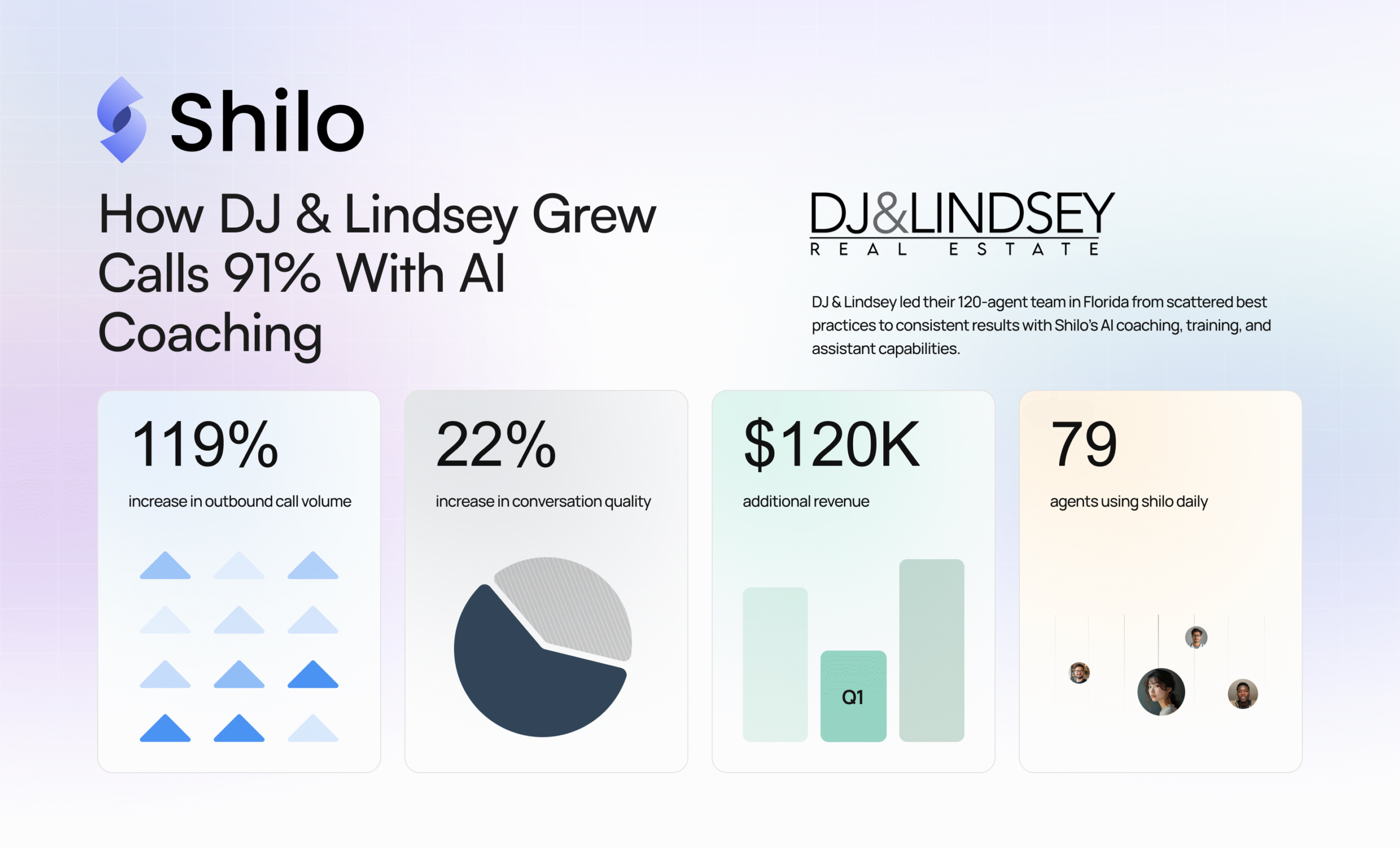
- They give feedback at the speed of the conversation. Not at the end of the week. Not at the monthly 1-on-1. After the call. The closer the feedback is to the behavior, the faster the behavior changes. One 79-agent brokerage saw outbound calls more than double over four months. Not because management pushed harder, but because agents who got immediate feedback built confidence through repetition.
- They make coaching specific, not generic. “You need to be better at objection handling” is useless. “On this call, when the lead said ‘we’re not ready yet,’ you could have said ‘I understand. Can I ask what needs to happen for you to feel ready, and when you’d realistically want to start looking?’ That’s the difference between a defined and undefined next step.” Specific beats generic every time.
- They identify what their best agents do and make it visible. Every team has a top performer or two who close at rates that seem unreachable. Most team leaders can’t tell you exactly what those agents say differently on the phone. The teams pulling ahead have found ways to surface those patterns and teach them to everyone else.
The common thread isn’t a particular tool or method. It’s a mindset shift: real estate team performance improves when conversation quality becomes a measurable lever, not a black box. The teams that build agent accountability into every call — not just the ones a manager happens to hear — are the ones whose pipelines, close rates, and retention look different from the rest.
And it starts with knowing what’s happening on the calls you can’t hear.
See What’s Happening on the Calls You Can’t Hear
Shilo analyzes every call your agents make — grading performance, flagging missed opportunities, and delivering coaching feedback before the next call starts. No extra headcount. No hours of listening. Just visibility into the 98% of conversations you’re missing right now.
Book a 15-minute demo and we’ll show you exactly how it works with your team’s calls.

Frequently Asked Questions
How many of my agents’ calls should I be reviewing?
Industry best practice suggests reviewing at least 5-10 calls per agent per month for meaningful coaching. For a team of 30 agents, that’s 150-300 calls per month, roughly 20-40 hours of listening time. Most team leaders review far fewer. Analysis of over 3 million calls suggests the average team leader hears less than 2% of total call volume, which means the vast majority of coaching opportunities go unnoticed.
What percentage of real estate leads are lost due to poor call quality?
Industry data indicates that real estate teams waste 40-60% of their lead investment due to inconsistent follow-up and poor call execution. The primary causes are vague or missing next steps, failure to ask for appointments, and slow response times to new leads. For a team spending $10,000 per month on leads, that’s $4,000-$6,000 per month ($48,000-$72,000 per year) that doesn’t convert because of what happens (or doesn’t happen) on the call.
Why do so many real estate agents quit?
According to NAR, 87% of real estate agents leave the industry within five years, with 33% not surviving their first year. While compensation uncertainty plays a role, a primary driver is the lack of structured, ongoing coaching. Agents receive initial training but rarely get consistent, call-level feedback on what they need to improve. Without a feedback loop, bad habits compound, leads don’t convert, and agents leave, often believing they “weren’t cut out for sales” when the real issue was a coaching gap.
What are the most common call mistakes real estate agents make?
Analysis of over 3 million real estate calls reveals three patterns that consistently kill deals: (1) failing to set defined next steps with a specific date, time, and method of follow-up, (2) not asking for the appointment even when the lead is clearly qualified, and (3) missing or poorly handling objections around timing, commitment, and existing agent relationships. These aren’t talent deficits. They’re trainable behaviors that improve rapidly when agents receive specific, timely feedback.
How much does it cost to replace a real estate agent who quits?
The full cost of losing and replacing a real estate agent typically ranges from $15,000-$50,000+ depending on the team’s structure. This includes recruiting costs, onboarding and training time, lost pipeline and pending deals, wasted lead investment during the ramp-up period, and the productivity drag on managers handling the transition. For teams experiencing the industry-average 87% five-year attrition rate, agent replacement is one of the largest hidden expenses in the business.
How can I improve my real estate agents’ call performance?
Start by measuring it. Most team leaders have no data on what’s actually happening on calls — just CRM activity and deal counts. The teams that improve agent call performance fastest focus on three things: tracking specific call behaviors (not just volume), delivering coaching feedback after each call (not once a month), and making top-performer patterns visible to the entire team. Manual call review works at small scale but breaks down past 10-15 agents.