
The #1 Behavior That Makes a Real Estate Lead 5.6x More Likely to Close
Last updated: February 25, 2026
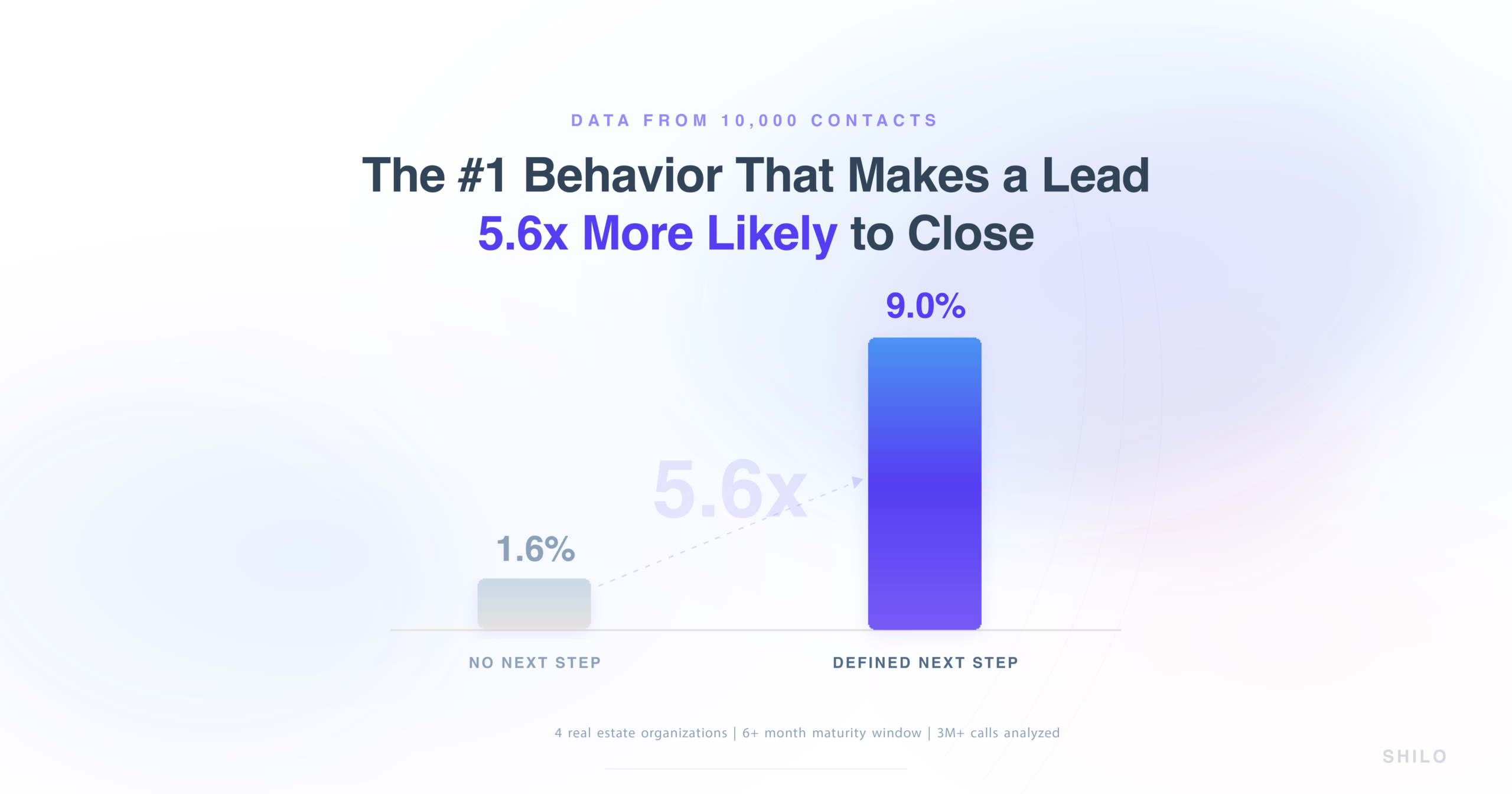
Contacts where a defined next step was set in the first 3 calls close at 9.0%. Contacts without one close at 1.6%. That’s a 5.6x difference – and it held across every team we studied.
We ran a formal study – 10,000 contacts across 4 real estate organizations, all from our platform of 3 million+ analyzed calls. I presented this data recently at a conference and the room went quiet. So I figured it was worth sharing more broadly, because the numbers are too big to keep on a stage.
What We Studied (And Why It Matters)
Over the past 16 months, we’ve analyzed more than 3 million real estate calls at Shilo. That’s the equivalent of 19+ years of continuous talk time compressed into data. We’re not guessing. We’re counting.
For this study specifically, we pulled 10,000 contacts across 4 real estate organizations. We only included contacts that had been in the system long enough to actually close – at least 6 months. No cherry-picking recent leads that haven’t had time to convert. Just contacts with a real outcome attached.
And here’s the thing most teams get wrong: they measure outputs. Call volume. Speed-to-lead. Appointment set rate. Conversion rate. Those are all scoreboards. They tell you who won. They don’t tell you what to fix.
We wanted to know something different: what behaviors during the call actually predict whether a lead becomes a client? We ran the numbers. One behavior stood above everything else.
The Data: 5.6x More Likely to Close
| Defined Next Step | No Next Step | Lift | |
|---|---|---|---|
| Close Rate | 9.0% | 1.6% | 5.6x |
| Appointment Rate | 84.3% | 25.3% | 3.3x |
10,000 contacts. 4 organizations. Only contacts with 6+ months to close.
Contacts with a defined next step set in the first 3 calls: 9.0% close rate vs. 1.6% without.
And notice it compounds. Setting a defined next step early doesn’t just get you a slightly better appointment rate. It 3.3x’s your appointment rate. More appointments mean more conversations. More conversations mean more trust. And that trust compounds into a 5.6x close rate.
Flip it around and the number is even more uncomfortable: without a defined next step in those first few calls, 98.4% of contacts never close. That’s not a guess. That’s our data.
This Holds Across Every Team We Studied
The skeptic in the room always says the same thing: “That’s one team. My team is different.” So we checked.
| Organization | With Next Step | Without | Lift |
|---|---|---|---|
| Justin Havre Real Estate | 12.54% | 1.61% | 7.8x |
| DJ & Lindsey | 12.13% | 2.19% | 5.5x |
| Power Real Estate Group | 5.74% | 2.81% | 2.0x |
| Frank Leo & Associates | 2.97% | 1.81% | 1.6x |
Different markets. Different team sizes. Different price points. Same pattern. No exceptions.
The lift ranges from 1.6x to 7.8x, but the direction is always positive. Every single team. This isn’t a fluke in one dataset. It’s a behavioral pattern that holds everywhere we look.
What’s a “Defined” Next Step?
Let me be specific, because the distinction matters.
Defined
“Can I call you Tuesday at 2pm?”
Specific time. Specific action. The lead says “yes.”
Undefined
“I’ll follow up sometime next week.”
Vague. No commitment. Easy to forget. Easy to ignore.
This isn’t just a sales tip I’m throwing out there. Psychologist Peter Gollwitzer studied 8,000+ people across 94 studies and found that goals with specific implementation plans are completed roughly 3x more often than vague intentions. When someone says “yes” to a specific time, their brain registers it as a commitment. Vague plans don’t get that same activation.
Robert Cialdini tells a great story about this in Influence. A restaurant owner in Chicago had a 30% no-show rate. He changed one sentence in the reservation process. Instead of “Please call if you need to cancel,” he said “Will you call us if you need to cancel?” Then he waited for the “yes.” No-shows dropped to 10%. Overnight. One word – asking for a verbal commitment – triggered a 67% reduction.
When your agent says “Can I call you Thursday at 3pm?” and the lead says “yes” – that “yes” changes their brain. They’ve made a micro-commitment. And people want to be consistent with their commitments.
It’s Not Just Us
We’re not the only ones who found this. Gong Labs analyzed 28,833 closed deals and found:
- Close rates decline 71% when next steps aren’t discussed on the first call
- 26% of introductory meetings skip next steps entirely
- Specific time-and-date CTAs produce a 37% meeting booking rate – more than double open-ended language
Stack that on top of our 10,000-contact study and the picture is clear. This isn’t one company’s opinion. This is what the data says across industries, across methodologies, across sample sizes.
The Math on Your Team
Let’s make this real. Take a team working 1,000 contacts over the next year.
With defined next steps in early calls: 9.0% close rate = 90 closed deals.
Without: 1.6% close rate = 16 closed deals.
At an average commission of $8,000 per deal, that’s $592,000 in GCI – the difference between “I’ll follow up sometime” and “Can I call you Tuesday at 2?”
Not because your agents are bad. Because nobody showed them the data.
And that $592K isn’t some theoretical maximum. It’s just the math from our study applied to a common team scenario. Your numbers will vary. But the direction won’t.
The Coaching Problem Nobody Talks About
Here’s the thing: your agents don’t know they’re not doing this.
They’re not choosing to skip next steps. They just don’t hear the gap. The difference between a mediocre call and a great call is usually 2-3 small improvements. Defined next steps is almost always one of them.
At 5 agents, you can catch this yourself. Listen to the calls. Give the feedback.
At 15, it gets hard.
At 50+, it’s impossible.
And the industry data backs this up. 48% of agents don’t follow up after the first call. Only 12% make a third attempt. Meanwhile, 78% of buyers go with the first agent who responds. The bar is low. And most teams are still tripping over it.
But when you make the gap visible – when agents can actually see whether they set a defined next step on every call – something shifts. They start self-correcting.
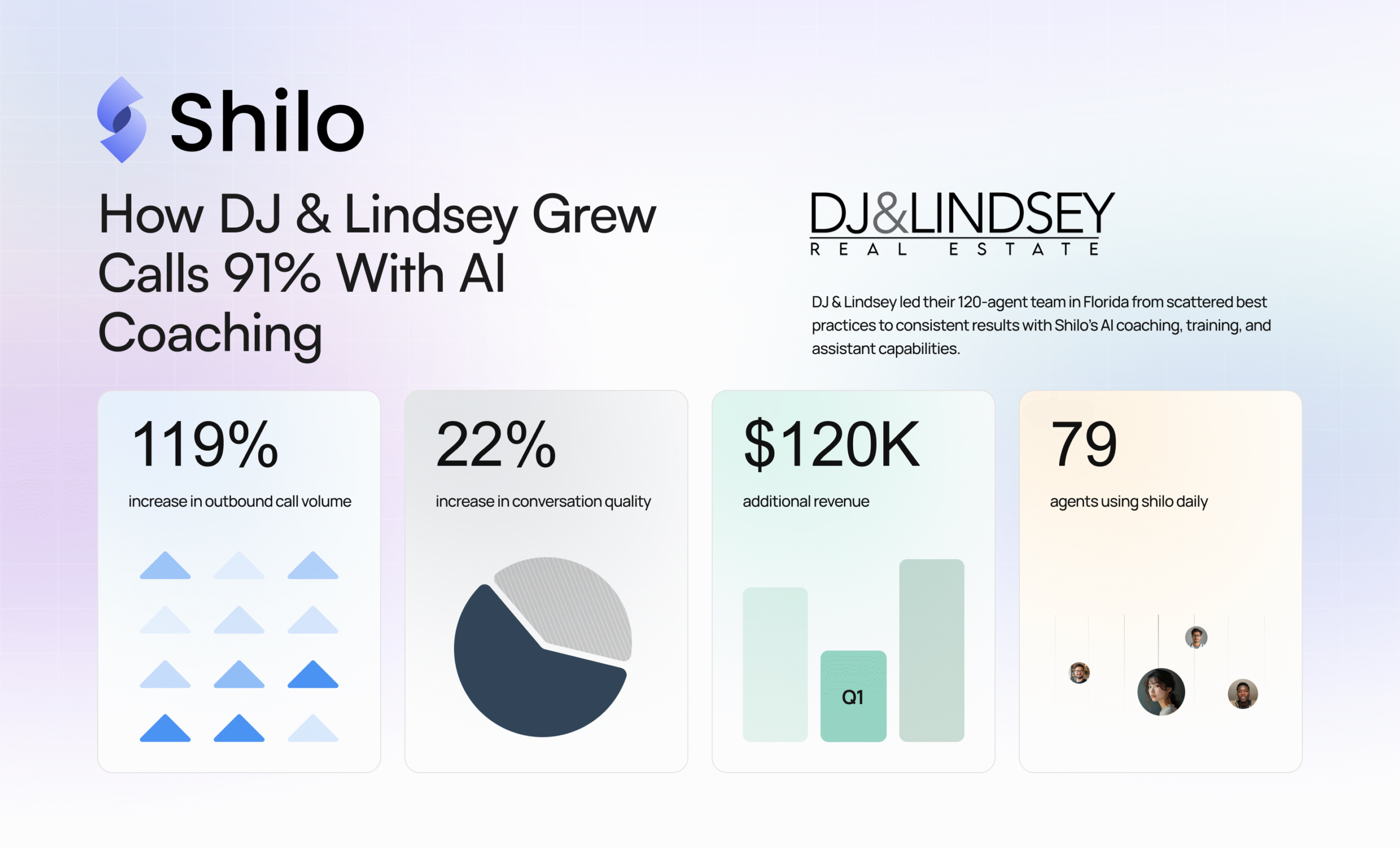
That’s exactly what happened with DJ & Lindsey in Saint Augustine, Florida. 79 agents. Scaling fast. No way to coach everyone manually. When their agents started getting feedback on next-step behavior automatically, the results were hard to argue with:
- Close rate with early next steps: 12.13% vs. 2.19% without – a 5.5x lift
- +91% call volume over 4 months
- +119% outbound calls
- 119 deals from 3,020 early-stage leads
- 650%+ ROI
Not because management pushed harder. Because agents could finally see what they were doing.
3 Things You Can Do This Week
You don’t need new tools or anyone’s permission. Start here.
1. Listen to 10 calls. Count defined next steps.
Pick 10 random calls from this week. How many end with a specific time and action? Not “I’ll follow up” – an actual date and time. You’ll probably be shocked at the number.
2. Teach the choice close.
“Does 2pm or 3pm work?” instead of “When’s a good time?” One sentence change. Train it in your next team meeting. The choice close reduces decision fatigue and gets a commitment in the same breath.
3. Start tracking next-step-set as a metric.
Not just appointment-set. That’s a lagging indicator. Next-step-set is the leading one. If this number goes up, appointments follow. It’s the behavior that predicts the outcome.
These three things will make your team better regardless of what tools you use.
See What Your Team’s Data Looks Like
The hard part isn’t knowing this. It’s seeing it across every agent, every call, every day.
You can listen to 10 calls. That’s great. Can you listen to a thousand? Can you track next-step behavior across 50 agents every week? That’s the problem we set out to solve when we built Shilo. It’s how we gathered all this data in the first place.
If you want to see what your team’s next-step rate actually looks like – your agents, your calls, your data – I’m happy to show you.

Frequently Asked Questions
What is a defined next step in real estate sales?
A defined next step is a specific, time-bound commitment made during a sales call. “Can I call you Tuesday at 2pm?” is a defined next step. “I’ll follow up sometime next week” is not. The difference is specificity and a verbal “yes” from the lead. Our data from 10,000 contacts shows leads with a defined next step in the first 3 calls are 5.6x more likely to close.
How much does missing next steps cost a real estate team?
For a team working 1,000 contacts per year, the gap between setting defined next steps (9.0% close rate) and not setting them (1.6% close rate) is 74 deals. At an average commission of $8,000 per deal, that’s approximately $592,000 in lost GCI annually. The exact number depends on your market and average deal size, but the magnitude is consistent.
What’s the difference between a defined and undefined next step?
A defined next step includes three elements: a specific time (“Tuesday at 2pm”), a specific action (“I’ll call you”), and a verbal confirmation from the lead (“Yes, that works”). An undefined next step is missing one or more of those elements – “I’ll follow up next week” has no specific time and no commitment. Behavioral research shows defined plans are completed roughly 3x more often than vague intentions.
How do I track whether my agents are setting next steps?
Start manual: listen to 10 random calls per week and count how many end with a specific time and action. Track next-step-set as a leading metric on a whiteboard or spreadsheet. At scale (50+ agents making 50+ calls per week), manual tracking breaks down – that’s 2,500+ calls to monitor. AI conversation analysis tools can detect next-step behavior automatically on every call.
What close rate should a real estate team expect?
Across our study of 10,000 contacts and 4 organizations, contacts with a defined next step in the first 3 calls closed at 9.0% on average. Without a next step, the average was 1.6%. Individual teams ranged from 2.97% to 12.54% with next steps set. The variance depends on market, team size, and lead quality – but every team showed significant improvement when next steps were present.
Sources
- Shilo Next Steps Conversion Analysis (February 2026) – 10,000 contacts, 4 real estate organizations, 6-month maturity requirement. Platform total: 3,000,000+ calls analyzed.
- Gong Labs – Analysis of 28,833 closed deals on next-step behavior and close rates.
- Gollwitzer & Sheeran – Meta-analysis of 94 studies, 8,000+ participants, on implementation intentions.
- Robert Cialdini, Influence – Research on verbal micro-commitments and behavioral consistency.
- NAR / The Close – Industry statistics on agent follow-up behavior and buyer preferences.