


How AI Technology Transforms Real Estate Agent Calls in 2025

In 2025, real estate still runs on phone calls. The call is where trust gets built, where objections surface, and where deals actually move.
But calls have a problem: they disappear. The moment an agent hangs up, everything that happened in that conversation lives in exactly one place, the agent’s memory. Multiply that by a team making hundreds of calls a week and you get a strange situation. The most important activity in the business is the one nobody can see.
That’s the problem AI call analysis was built to solve. I want to walk through what the technology actually does, what 3 million analyzed calls taught us about where deals die, and what happened when a real team turned it on.
What AI Call Analysis Actually Does
The mechanics are simple to describe. The system records and transcribes every call, using speech-to-text models trained on real estate vocabulary (terms like “contingencies,” “escrow,” and “pre-approval” that trip up generic transcription). Then it analyzes the conversation itself: what the lead asked, which objections came up, whether the agent set a next step, how the call opened and closed.
From there, a few things happen automatically:
- Every call gets graded against real-estate-specific criteria (at Shilo, that’s a 1-5 star system)
- Key moments get flagged, so reviewing a call takes minutes instead of the 15-30 it takes to listen end to end
- Summaries and follow-up tasks get written back to the CRM
- The agent gets coaching feedback, including the exact line they could have used, before their next call
One thing I’ll insist on, because it matters: this shouldn’t be a black box. When Shilo grades a call 3 stars, we show you how it arrived at that conclusion, with cited evidence from the transcript you can click into and verify. If an AI tells you an agent is weak at objection handling, you should be able to see the receipts.
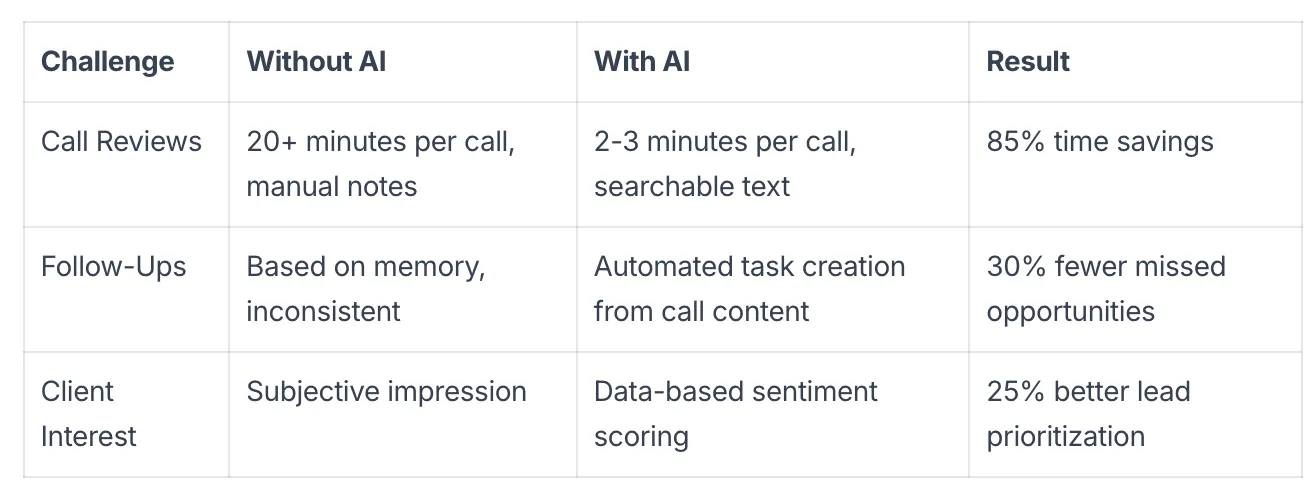
What 3 Million Calls Taught Us
Here’s why this matters more than most teams realize. At Shilo we’ve analyzed over 3 million real estate calls, more than 21 years of continuous talk time across 7,000+ agents. The picture that data paints is uncomfortable.
Team leaders hear less than 2% of their agents’ calls. Only about 1.5% of calls earn the highest quality rating. And the single biggest behavior gap is also the most fixable one. We ran a study of 10,000 contacts across 4 organizations: contacts where the agent set a defined next step in the first 3 calls closed at 9.0%. Without one, 1.6%. That’s a 5.6x difference, and the behavior behind it is one sentence at the end of the call.
Manual call review can’t catch any of this at scale. A 30-agent team making 15 calls per agent per day generates 60 hours of conversation daily. You’d need 7.5 full-time people doing nothing but listening. Nobody has that, so the coaching gap stays invisible.
What Happens When a Team Turns It On
Cool, but does it move the numbers?
DJ & Lindsey Real Estate, a 79-agent brokerage in Saint Augustine, Florida, started running every call through AI coaching in October 2024. Over the next 4 months, outbound calls more than doubled, from 508 to 1,112 per month. Total call volume grew 91%. From 3,020 early-stage leads worked in that window, 119 deals closed, a 3.94% conversion rate. One agent improved their call quality score 45% in 4 months.
And honestly, the mechanism wasn’t management pushing harder. Agents could see their own scores after every call, so they started self-correcting. Feedback that used to arrive at the end of the month (if at all) showed up before the next dial.
The 3 Questions Every Team Asks First
Is this legal?
Call recording laws vary by state. Some states require only one party to consent to recording, others require everyone on the call to agree. Modern platforms handle this with automatic disclosure messages at the start of calls, documented consent in the transcript, and state-specific settings. Check your local laws first; this part isn’t optional.
Is the data safe?
Client conversations contain sensitive details about money, timing, and personal circumstances. Look for encryption on all call data and access controls so only authorized team members can see transcripts and summaries. The same standards as online banking.
Will my agents actually use it?
This is the real question, honestly. Nobody wants to feel surveilled. What we’ve seen is that adoption follows from the feedback being useful to the agent, not just visible to the boss. When we beta-tested our 1:1 Coaching feature with 200 agents, sessions averaged 13 minutes, and no dimension we measured (enjoyment, helpfulness, how personalized it felt) scored below 7 out of 10.
Where This Is Headed
I don’t think AI replaces real estate agents. I think it does the robot work (transcribing, logging, tracking, reminding) so agents can get back to the human work: the conversation itself. That’s the whole point of this technology. The teams adopting it aren’t getting more robotic. They’re getting more personal, with better information.
If you want to see what this looks like on your own team’s calls, book a demo and we’ll walk through it together. Your calls, your data, no pressure.
Frequently Asked Questions About AI For Real Estate Calls
How does AI adapt to different real estate markets and property types?
The models learn from millions of calls across markets, from luxury to residential to rentals. More important, the behaviors that predict outcomes hold everywhere we've looked. In our 10,000-contact study, defined next steps lifted close rates at every one of the 4 organizations, ranging from a 1.6x to a 7.8x improvement.
What measurable improvements can teams expect from AI call analysis?
Your numbers will vary, and I'm not going to overpromise. The best verified example we have: DJ & Lindsey Real Estate grew outbound calls 119%, grew total call volume 91%, and closed 119 deals in 4 months, returning $120,000 in incremental revenue against a $16,000 cost under the most conservative attribution model.
How does AI call technology integrate with existing real estate CRM systems?
Shilo connects directly with Follow Up Boss, Sierra Interactive, BoldTrail, Lofty, CINC, SureSend, and Bonzo, syncing call data, summaries, and action items automatically so client information stays in one place.
What training do agents need to use AI call technology?
Very little. Calls are captured through the phone systems agents already use, so there's nothing new to remember. Most agents learn the basics in about an hour, and the coaching feedback itself is written in plain language, not analyst jargon.